Dubai beyond the malls
Most Dubai trips never leave an air-conditioned loop: mall, hotel pool, tallest building, mall again. That version exists and it's fine, but it skips the reason Dubai Creek is still lined with wooden dhows loading cargo the same way they did a century ago, a few hundred metres from towers that didn't exist twenty years ago. This trip spends its first days on that older water before the newer skyline gets its turn, then crosses to Abu Dhabi for a day to see how the capital does the same ambition more quietly, with fewer photographs and considerably less noise about it.
Days 1-4 · Old Dubai, along the creek
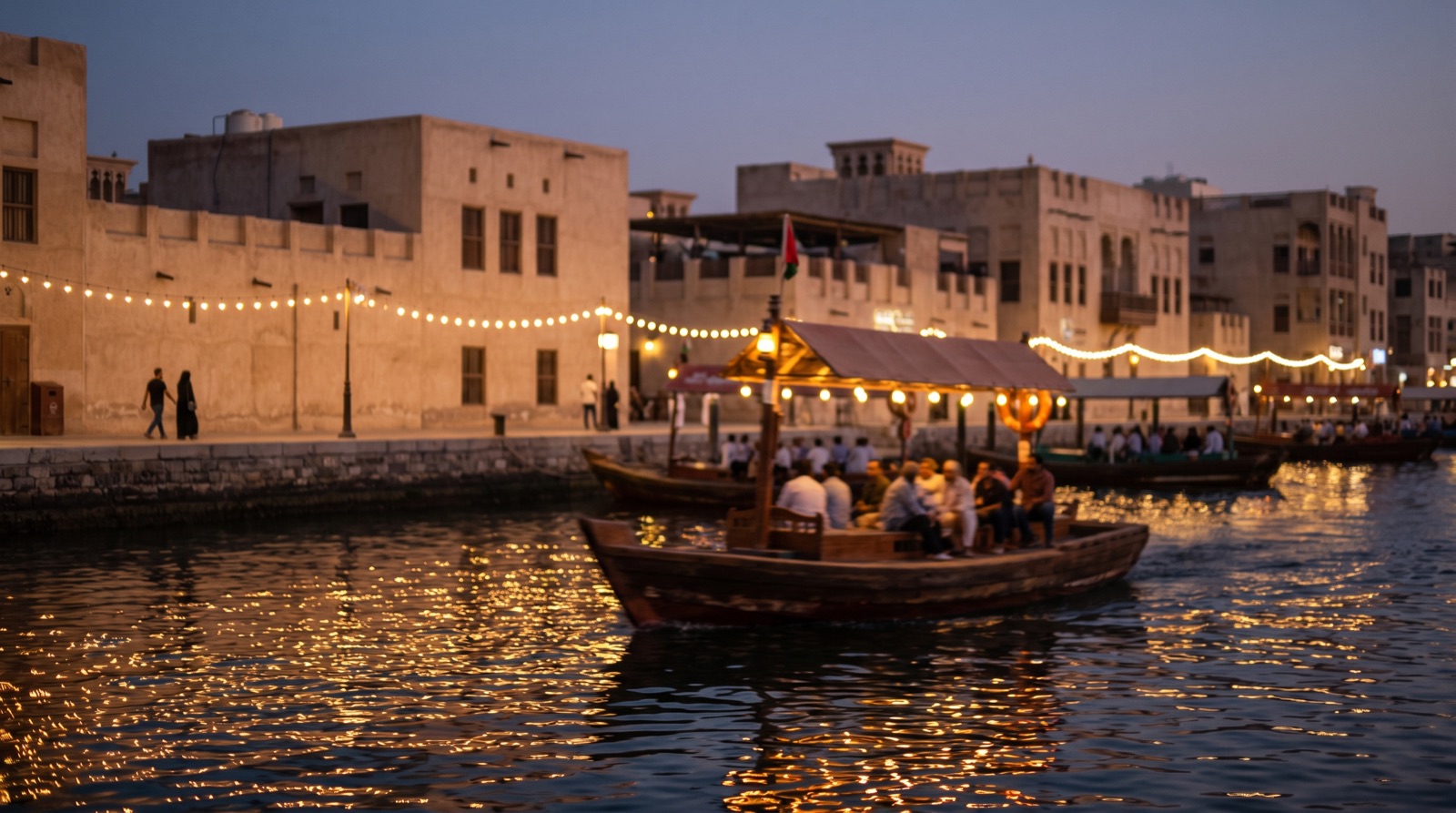
Start at Dubai Creek itself, the saltwater inlet that the whole city grew up around before oil or towers entered the picture. An abra, a small wooden ferry, crosses between Bur Dubai and Deira for the price of a coffee and gives you the best view in the city for a fraction of what any observation deck charges. Take it more than once; the crossing itself, past dhows loading everything from air conditioners to car tyres bound for East Africa, is the actual attraction.
The Gold Souk and Spice Souk in Deira are worth an unhurried morning, ideally before 10am when the covered alleys are still cool and the shopkeepers aren't yet mid-haggle with a tour bus's worth of customers. Al Fahidi Historic Neighbourhood, on the Bur Dubai side, preserves the wind-tower architecture that once cooled homes before air conditioning existed, and the Dubai Museum inside Al Fahidi Fort gives the century of context that the skyline alone doesn't offer.
The wind towers themselves are worth pausing to actually understand: barjeel, four-sided funnels built into rooftops to catch any passing breeze and channel it down into the rooms below, an entirely passive cooling system that worked for generations before the first air conditioner arrived in the Gulf. A handful of restored courtyard houses in Al Fahidi let you stand underneath one and feel the draught still working, which explains more about how this city survived its own climate than any museum label could.
Eat where the taxi drivers eat: Al Ustad Special Kabab, running since the 1970s near the creek, or one of the small Iranian and South Asian restaurants clustered around Meena Bazaar, both a world away from the brunch buffets the hotels advertise. A single plate here, chelo kebab with grilled tomato and a mound of saffron rice, costs a fraction of anything in the tourist strip and comes from a kitchen that's had decades to get it right. Give one evening to the newer city on its own terms: the Burj Khalifa's observation deck, booked for sunset rather than midday to avoid both the heat haze and the peak crowd, and the Dubai Fountain show afterwards, free and genuinely worth the ten minutes.
Jumeirah Mosque runs a guided tour open to non-Muslim visitors most mornings, one of the only mosques in the country that does, and it's a better hour for understanding the country's culture than most paid attractions manage. If the heat allows, a desert safari in the late afternoon, dune bashing followed by dinner at a camp under a sky with none of the city's light pollution, earns its reputation more than the marketing suggests, provided you book with an operator that limits group size rather than running a convoy. The stars alone, unobscured by any glow from the towers behind you, are worth the drive out regardless of how the dune bashing itself goes down with a nervous stomach.
Day 5 · Abu Dhabi, the quieter capital
Abu Dhabi is about ninety minutes down the highway and does the same scale as Dubai with noticeably less noise about it. The Sheikh Zayed Grand Mosque, one of the largest in the world, is free to visit and genuinely worth the modest dress code requirements: white marble, gold detailing, and a single hand-knotted carpet covering the main prayer hall that took years to make. Go mid-morning for the best light on the domes and the smallest crowd.
The Louvre Abu Dhabi, a genuine branch rather than a licensing exercise, houses a collection spanning global art and history under a dome that filters light like a man-made forest canopy; it's worth the ticket even for visitors who'd normally skip a gallery. Qasr Al Watan, the presidential palace open to the public, rounds out a day that shows a different, calmer version of Gulf ambition than Dubai's skyline sells.
Finish the day at the Corniche, Abu Dhabi's long waterfront promenade, timed for the hour before sunset when the heat has broken and the whole city seems to walk the same stretch of pavement at once. It's a smaller-scale, more residential version of what Dubai's Marina tries to be, and it's a genuinely pleasant way to close a day built around two enormous buildings.
Day 6 · Your own chapter
Al Seef, the newer waterfront development built to resemble the old creek-side architecture it sits beside, if you want a gentler last day of shopping and cafés. The Museum of the Future, if you booked ahead and want one dose of the futuristic Dubai everyone expects, its silver ring of a building now as photographed as the Burj itself. Or take one more abra crossing at sunset and let the creek be the last thing you see of this city, the way it was probably the first, before any of the towers had a chance to compete for your attention.
Send one home from {destination} - your photo, fourteen words, and a stamp that gifts data back.
{destination} eSIM from {price} - and your first postcard home is free.
More places to take it
All guides →