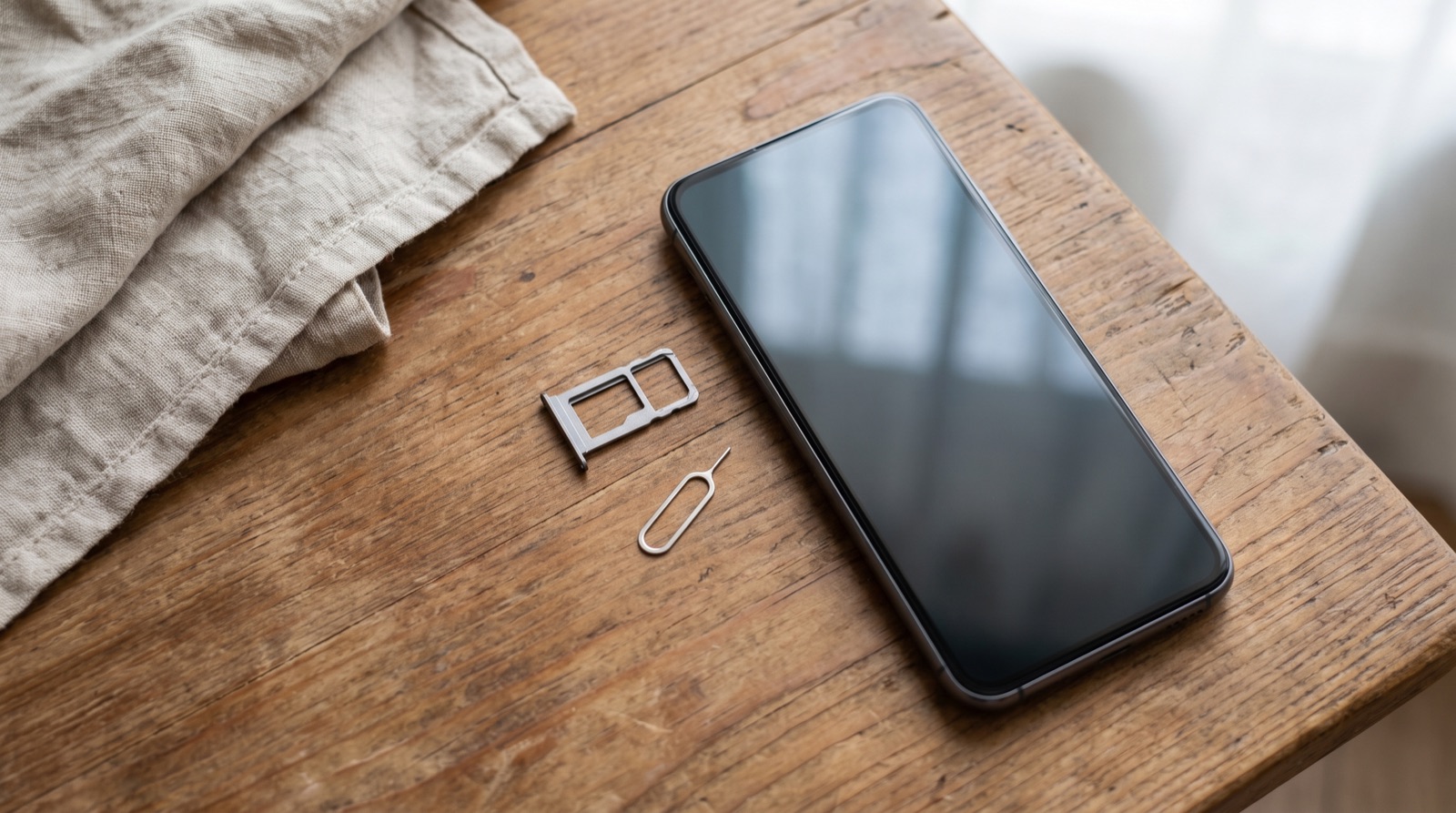
Last lesson covered what an eSIM is. This one is shorter, because the honest answer to "what changes?" is: less than the marketing suggests. Your calls sound the same. Your data runs at the same speed, on the same towers, sold by the same networks. The difference is entirely in how the SIM gets onto your phone, and a couple of things that follow from that.
The part that's identical
Both a physical SIM and an eSIM store the same kind of thing: a small set of credentials that prove your line to a network and tell your phone which one to use. Neither one makes your phone faster, your signal stronger, or your battery last longer. If a shop tries to sell you an eSIM on the promise of better reception, that shop is selling you a story.
Security is identical too, in the ways that matter day to day. Both formats authenticate you the same cryptographic way, and both can be suspended or reissued by your provider if something goes wrong. The one practical difference: a physical SIM can be physically removed and read by anyone who gets hold of your phone and a paperclip, however briefly. An eSIM can't be popped out at all, which makes it marginally harder to lift a working line off a stolen or borrowed handset.
The part that changes
Delivery is the whole story. A physical SIM is a tray, a pin, and a piece of plastic you can lose in a sofa. An eSIM is a QR code or a tap, and it lives in your phone's software from the start. That means no waiting for post, no queueing at a kiosk, and no small plastic rectangle to keep track of once you've swapped it out.
It also means you can hold several eSIM profiles on one phone at once, switching between them in settings instead of physically swapping cards. Most people use this to keep a home line and a travel line running side by side - which is worth its own lesson, and gets one: dual SIM done right.
Where eSIM wins outright
For travel specifically, eSIM wins on every count that matters at an airport. You buy it before you leave, it costs nothing while it sits unused, and it activates the moment you land - no queue, no kiosk, no scratch card with a number you have to text to an unfamiliar shortcode.
There's a quieter win too: you can't lose an eSIM on the trip itself. A physical travel SIM, swapped in at a foreign kiosk, means your original home SIM has to go somewhere - a wallet pocket, a hotel safe, a jacket you leave on a train. An eSIM stays soldered in, so there's nothing small and vital to misplace between the airport and the hotel.