Cairo and the Nile, and how to haggle without the flinch
Egypt punishes a spreadsheet itinerary and rewards a traveller who slows down. Cairo looks like pure chaos from a taxi window: five lanes of traffic painted for three, horns used as punctuation, a call to prayer laid over the top of all of it. Give it a day and the chaos turns out to have a rhythm, the same way a stallholder pouring you tea in Khan el-Khalili isn't stalling you, he's opening a conversation. Haggling here isn't a test you can fail. It's a negotiation everyone in the room already knows is provisional, and once you stop treating it like an exam, it gets genuinely fun.
Days 1-3 · Cairo, at its own pace
Do the pyramids first, and do them early. Gates at Giza open around 6am in the warmer months, and the gap between arriving then and arriving at eleven is the gap between having the Khafre causeway mostly to yourself and sharing it with forty coaches. Go before the plateau turns into a griddle. Hire a guide at the gate rather than online, ask to see the official badge, and decline the camel ride pitch as many times as it takes. The Grand Egyptian Museum sits close enough to fold into the same morning, and it earns a full three hours on its own, so treat the pyramids as the sunrise half of the day and the museum as the shaded half.
Give one late afternoon to an ahwa, one of the old coffeehouses tucked into the medieval quarter near Bab Zuweila, where the tea is sweet, the backgammon boards are chipped, and nobody minds you staying two hours over one glass. It's the best place to let your feet recover and to watch Cairo's rhythm up close instead of from a taxi window: deliveries balanced on a single motorbike, a call to prayer answered by five different minarets a half-beat apart, an argument over a parking spot that resolves itself in laughter.
Spend an afternoon in Islamic Cairo, where minarets outnumber apartment blocks and Al-Muizz street runs past a thousand years of buildings still in daily use, not preserved behind rope. Let that tip you into Khan el-Khalili by early evening, once the lantern light comes on and the bazaar gets loud in the good way. Haggling follows its own rhythm here: the first price is an opening line, not an insult, and a proper back-and-forth over an alabaster bowl or a length of cotton is half the point of buying it. Start around forty percent of the asking price, meet somewhere in the middle, and take the tea if it's offered. Walking away is a real tactic, not rudeness, most sellers will call you back within ten paces if the number was ever going to move. The same instinct serves you well in the street markets of Brazil, if you're building a habit of it.
One honest warning: taxi meters in Cairo are decorative at best. Agree the fare before you close the door, or skip the negotiation entirely with a ride-hailing app.
Days 4-6 · Luxor, and the Nile at boat speed
Take the sleeper train south, not the flight. You lose an evening and gain a proper sense of how far the Nile valley actually runs before you wake up in Luxor with the temples already close. Karnak at opening, around 6am, is a different building to Karnak at noon: empty colonnades instead of tour groups, and stone that hasn't yet started radiating heat back at you. Cross to the West Bank for the Valley of the Kings before the sun gets serious, and save the Colossi of Memnon for the drive back, when everyone else has gone in search of shade.
If you're an early riser twice over, a hot air balloon lifts off the West Bank around dawn and clears the ridge just as the light hits the Valley of the Kings from the side rather than straight above, which is when the tombs actually look like they're sitting in a landscape rather than a car park. It costs a proper morning and a full night's sleep you won't get, but nobody who's done it has regretted the trade. If ballooning isn't your pace, the Tombs of the Nobles nearby get a fraction of the Valley's crowds for roughly the same craftsmanship.
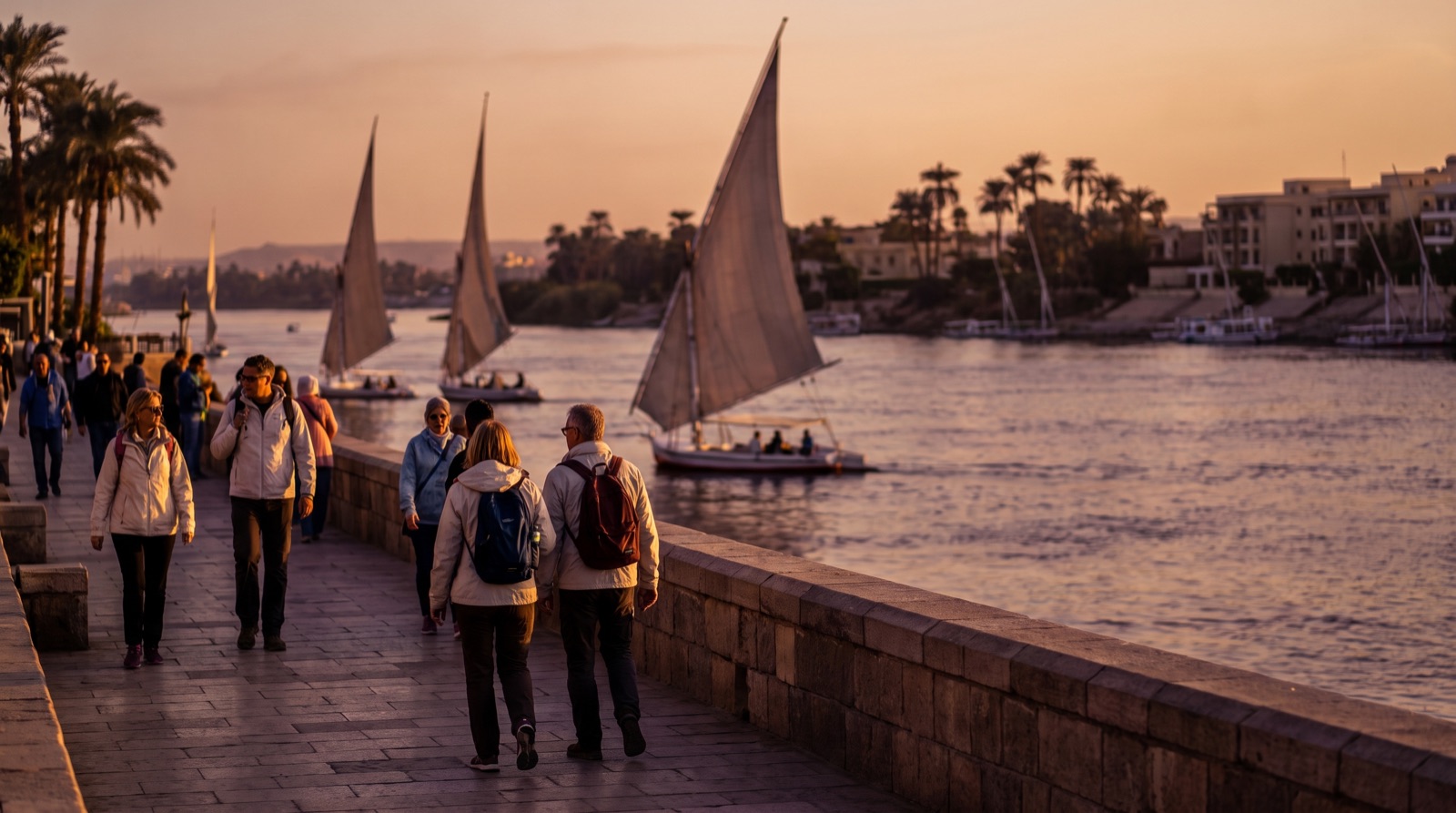
Evenings belong on the water. Book a felucca out of the Luxor corniche for the hour before sunset, when the light turns the same colour as the temple sandstone and the boatman cuts the motor to catch a gust, no engine, no schedule, just the current and whatever conversation started at the dock. Agree the hourly rate before you cast off, the same way you'd agree a fare, and it stops being a negotiation and starts being an afternoon.
Day 7 · Your own chapter
Where you go next depends on what the first six days told you about yourself. Continue south to Aswan for Nubian villages, botanical islands, and a Nile that slows down until it feels more like a lake, most cruises turn around here. Cut east to the Red Sea coast, to Hurghada or the diving town of Dahab, if you'd rather trade temples for reef for a few days. Or head north to Alexandria, where the Mediterranean turns the whole mood European within an afternoon and the corniche has the same pull toward the water as Greece, island by island. We won't choose for you. The best last stretch of any Egypt trip is the one that wasn't in the guidebook.
the river does not rush, and neither should you
haggle like it's a handshake, not a fight
Send one home from {destination} - your photo, fourteen words, and a stamp that gifts data back.
{destination} eSIM from {price} - and your first postcard home is free.
More places to take it
All guides →